Animals in Art: Kids Love Them

The Cave of Altamira in Spain is famous for its Paleolithic cave paintings.

Kids love animals, and so it only stands to reason that they also appreciate viewing and creating their own animals in art. Throughout history, artists have always created drawings, paintings and sculptures of animals. Cave art reveals ancient paintings that date back tens of thousands of years in which animals are portrayed. Ancient Egyptian artists often depicted gods with the heads of animals. Tribal art generally features a combination of animal and human characteristics that seem to symbolize man’s bond with his natural environment. Mythical beasts of the Middle Ages decorated medieval manuscripts with creatures that sometimes took on secret symbolic associations. Art of the 17th Century featured hunting scenes with dramatic life and death struggles, while 18th Century artists celebrated the natural beauty and majesty of animals in their natural habitats. Victorian artists of the 19th Century painted sentimental pieces of their domestic pets and livestock, while artists in the 20th Century explored a wide range of animal genres and invented some, as well. As we get underway with the 21st Century, we see wonderfully diverse animal artisans.

"Northern Monarch" by Solberg is a great example of his breathtaking watercolor originals.

Abrakadoodle features a number of talented contemporary and classic artists who inspire students with their animal creations. Mort Solberg is a wildlife painter and an Abrakadoodle Artist of Distinction. Children love to create art in his style that  incorporates the use of a large paint brush to create art that combines realism with abstract images. Mort brings his love of nature and the outdoors into his award-winning art, and he wants to foster that appreciation in children.

"Zara the Zebra" by Sophie Harding.

Contemporary artist Sophie Harding enchants kids everywhere with her adorable animal creations fashioned in a Naïve Art style that feature simple shapes and vivid colors. Born in England, Sophie received a diploma in General Art and Design, followed by a bachelor’s degree in Fashion and Textiles at Central St. Martins. Her training has motivated her to use many different types of artistic media in her work. In addition to Naïve Art and fine art prints, Sophie is a successful illustrator of children’s books and magazines, greeting cards, gift wrap, calendars, tableware and textile designs.

Robin Anne Cooper created canvas collage originals featuring Abrakadoodle’s arty dog Splat.

Upon discovering the unique works of Robin Anne Cooper of South Carolina just a couple of years ago, Abrakadoodle commissioned her work for holiday gifts. Robin created 52 unique canvas collages featuring Abrakadoodle’s arty dog mascot Splat. Robin uses a unique style of canvas collage in which she paints, cuts up and then produces a new piece featuring such whimsical subjects as cats and dogs. Robin Anne Cooper believes in creating original, affordable art. “Kids so often associate art with well known artists of the past like Picasso and Rembrandt,” commented Abrakadoodle’s co-founder and CEO Mary Rogers, adding, “Abrakadoodle features these classic artists, as well as some of today’s working artists like Robin Anne Cooper, who create amazing artwork that inspires kids to be creative and to see how real people incorporate art into their lives and their work.”

Artists for Kids: John M. Barber

Exposure to art, creativity and art education can have an important impact in a child’s life. John M. Barber discovered his destiny at the age of seven while visiting North Carolina’s Atlantic shore and watching an artist creating a lighthouse and the vast sea beyond. Years later, he studied art in Virginia at Virginia Commonwealth University. There he was introduced to the nearby Chesapeake Bay, where he fell in love with the sea and the story of the Chesapeake and its people.

Barber’s work is a great reference for any art education teacher. He painted more than 500 pieces of art illustrating the bay’s every aspect. While he also painted other subjects, the effect of light on his scenes always captivated him. Inspired by Barber’s creations, children can learn how to create light on their own artwork. Often, organizations and individuals commission Barber scenes imagined by them. John Barber creates the scenes, but he always imprints the pictures with his creativity and unique style.
What Kids Can Learn From Barber
(Art for Kids)

Barber’s work is about environment and all his paintings have a beautiful glow of light in them. Children can learn about a technique called bull’s eye painting from the art of John Barber. In bull’s eye painting the main subject is painted with a light color while darker colors are painted around the outside. This effect directs the viewer’s attention to the main object of the painting.

John M. Barber: Painter, inspired by “A Winter’s Evening on the Hill”

Art for kids needs to be fun and creative. The wax resist method is an easy technique that challenges the children while they learn to create light on a painting. Children can draw a seascape using a white or light color crayon. After wetting the paper with clear water they can paint the picture with watercolor. Starting with yellow at the center of the paper they can add darker colors in a circular fashion creating light on the painting while revealing their drawing.

Learn more about Barber on the web at:
http://www.johnbarberart.com/

Artists For Kids

Contemporary artists should be a part of any art education program. Melanie Smythe is an artist from Texas. She is a botanical illustrator who loves to draw flowers. She uses many techniques including pencil, pen, ink, graphite crumbs on mylar, watercolor, colored pencil, computer drawings, etc. Her work is called scientific illustration, which accurately depicts plant life found in nature. Scientific illustrators are always telling a story using drawing and composition to visually explain the structure, organization and relationship of an object. Smythe works together with scientists to be able to interpret and reconstruct her images with accuracy. Her art work is a great addition to art education since she applies creativity to science. Smythe brings art to kids by participating in Abrakadoodle’s Artist of Distinction program.

What Kids Can Learn From Smythe
(Art for Kids)

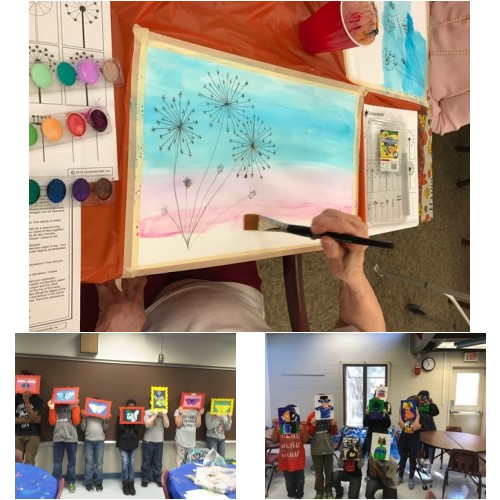
Melanie Smythe studies each flower before drawing it. Children can learn so much about nature while observing a flower. They can learn about the flower’s structure while using different techniques to represent it. Children can learn to use watercolor by blending colors, creating value with thin overlapping strokes, drawing lines, texture and more while painting a flower. Melanie’s art helps children appreciate nature by representing it through her unique style – a blend of creativity and science.

Smythe inspires creativity in children with her style which uses dots instead of lines. She teaches children to use this technique of applying hundreds of dots in a pattern to produce a flower. The dots are put closer together to make the image darker, and farther apart to make it lighter. This technique is called stippling, and children learn how to represent light and shadows. Her style lends itself to art education at its best!

Learn more about her work at: